

Understanding Dyslexia: Why It’s Not Really a Reading Problem
Dyslexia is often characterized as a reading difficulty. But that is simply one of its more obvious symptoms. People with dyslexia have problems processing language. This may involve any language component, from sounds to words and sentences.
Although the sound, or phonological, component is often mentioned, research also finds associations with other parts. Similarly, any language function–speaking, listening, reading and writing–may be affected to different degrees in different individuals.
On the surface, difficulty with reading is called dyslexia; difficulty with writing, dysgraphia. But really, the common denominator across this spectrum of difficulties is language processing.

Why Parents Often Wait to Address Dyslexia
First-time parents especially may not realize that anything is amiss with their children’s language development in the early years. Also, some children who are expressive in speech may still face problems learning to read later. When these children fall behind their classmates, teachers often reassure parents that “it’s just developmental.”
By third grade, students are supposed to have gone past “learning to read” to “reading to learn.” That is, by 3rd grade, they should have mastered reading sufficiently to use it to get new knowledge. At this point, reading difficulty becomes apparent and if not resolved, the achievement gap between struggling learners and their typical peers continues to widen throughout their school years.
By middle school, the reading problem becomes glaringly obvious to everyone, including the struggling learner’s peers. Thus, what started as a purely language-processing problem evolves into a tangled web of psycho-social issues affecting family life, social relations, emotional well-being and self-esteem. Ineffective programs are thus harmful on multiple fronts. They make struggling learners doubt their own intelligence and effort.
By now, families may have tried just about everything affordable and available: tutors, dyslexia specialists, summer school, online programs. Unless the program tackles the reading problem head-on by getting to the root of dyslexia, it likely won’t work well enough to achieve on-grade reading. This is because we need to first understand what dyslexia really is.
So, What Is Dyslexia, Exactly?
Dyslexia is a language-processing difficulty. In academic definitions, dyslexia is most commonly defined through difficulties with word reading, decoding, and spelling. People who have difficulty processing language may show problems with any part of language, from sounds to words and extended text. They may find any language function–speaking, listening, reading and writing–challenging. When reading is affected, it is called “dyslexia.” Many individuals have problems with more than one language component and function.
Because dyslexia is so prevalent, affecting 1 in 5 people, it cuts across all demographics, socio-economic status, region, ethnicity, age, IQ, and gender. It is a neurological condition in that the brain of someone with dyslexia operates differently from the typical. One noticeable example is in rhyming. Some children with dyslexia may not know how to create rhyming words, like car and far. But typically developing children all over the world do this naturally as part of language play.
However, this does not mean that the brain of a person with dyslexia will remain so for the rest of their life. Neuroplasticity refers to the brain’s ability to reorganize itself, to change. Thus, dyslexia can be a temporary condition.
What it is:
- Difficulty processing language
- Reading difficulty rooted in language processing
- A neurological condition
What it is not:
- A question of intelligence
- A motivation issue due to laziness
- A vision problem
- A permanent brain condition
The Myths That Keep Children From Getting Help
Myth 1. Dyslexia is About Seeing Letters Backwards
Dyslexia is a language problem, not a vision issue. This myth persists because some people do mix up letters like “b” and “d.” These letters are close in sound, not just in shape. Some people with dyslexia have trouble securing the representation of speech sounds and their relationship to letters. Thus on the surface, they seem to have difficulty recognizing letters.
Myth 2. They’ll Grow Out of It
With dyslexia, the brain processes language inefficiently. This problem will not go away unless the brain is trained to do so efficiently. Research finds that if the problem is not resolved, students with dyslexia fall further and further behind their typical peers in reading.
Myth 3. They Just Need to Try Harder
Typical reading development occurs rather quickly. When a child has to work hard at learning to read and has to spend an unusual amount of time learning to spell and recognize even common, simple words, then the case merits further investigation.
Myth 4. Dyslexia Mostly Affects Boys
Dyslexia affects both boys and girls. But boys may attract more attention because of more overt displays of the problem, such as behavioral issues.
Myth 5. Dyslexia is Lifelong
Dyslexia is due to inefficient language processes in the brain, which can be corrected. Diagnosed by certified psychologists as having dyslexia, children who completed Dysolve were able to pass state/school standardized reading tests, take no more than typical to complete schoolwork and tests, and spell, read and write as well as their typical peers.
Myth 6. Dyslexia is Only a Small Subset of Reading Difficulties
Dysolve® AI’s evaluations of struggling readers all show language processing inefficiencies, regardless of whether they had been diagnosed with dyslexia by specialists. Dyslexia affects 20% of students, yet schools do not often provide intervention for 20% of their students.
Myth 7. “Evidence-Based” Means Positive Evidence
Methods under study are considered “evidence-based” (Institute of Education Sciences). The Department of Education What Works Clearinghouse does not contain any rigorous, replicable study of a reading intervention that has positive effect on broad reading achievement for students with dyslexia who are in grade 3 and up.*
*Dysolve AI is new. Its clinical trial produced positive evidence.
See How to Evaluate Studies and Programs
Myth 8. The Most Expensive Interventions Are The Best
Dyslexia interventions presently require highly trained, certified reading specialists to work with students one-on-one or in small groups. Hence the cost. Yet these interventions only help students cope with their reading difficulty year after year. An AI program can be effective and costs less than 10% of these specialist-led interventions.
See Cost of Dysolve v. other methods
Myth 9. The Most Expensive Evaluations Are The Best
The best evaluation is one that forms the blueprint for intervention. None of the traditional evaluations, no matter how lengthy, does this. Only Dysolve® does.
The Real Root of the Problem: Language Processing, Not Reading
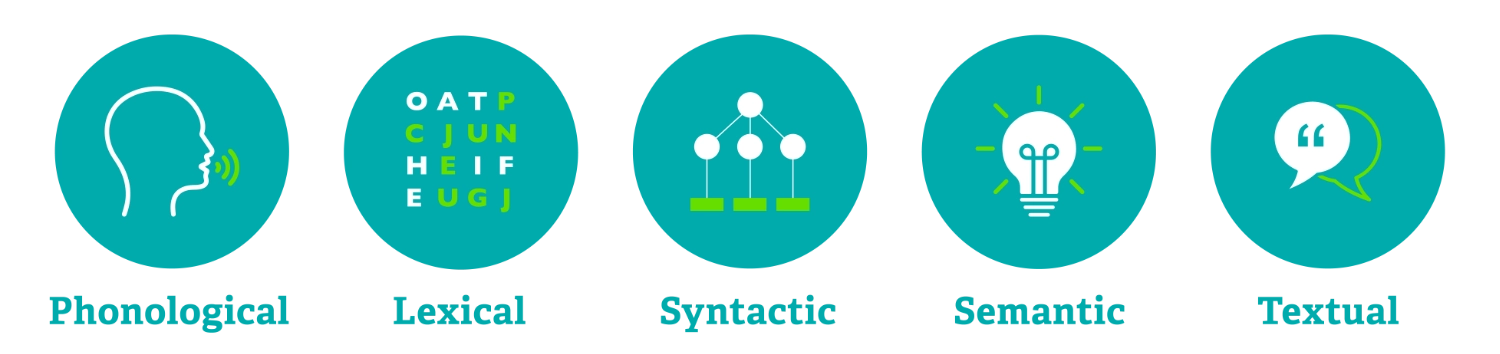
Think of a large computer operating system. It has many components, and each one is made up of millions of lines of code. When there are errors in the code, the system may get glitchy, grind to a halt, or crash. To get the system running smoothly, we have to find the bits and bytes of error in the code.
Dyslexia is like that. Some children show language issues occasionally, others read haltingly, and some break down completely in the midst of a task. Dyslexia is due to how the brain processes language, and the linguistic system in the brain is like a gigantic operating system.
The linguistic system comprises many language components, such as the phonological (sounds), morphological (parts of words) and syntactic (sentences).
Each language component itself is made up of many sub-components, down to atomic units. For example, the phonetic component of contemporary American English does not just have 37 speech sounds or phonemes. Each phoneme itself is composed of at least 13 phonemic features, or atoms of sounds.
Usually, many parts are affected across components for any one individual who has problems processing language. Language processing refers to how the brain receives verbal input and produces verbal output. These are carried out through language functions, namely speaking, listening, reading and writing.
Although dyslexia is often discussed mainly in terms of speech sounds or phonological processing, research has linked it to difficulties across other language components as well, including morphology and meaning. This helps explain why dyslexia does not always look the same from one person to another.
Because of the large number of possible combinations of inefficient language processes across the population, these difficulties show up across a broad spectrum on the surface. This is why dyslexia does not seem like a unitary condition, with everyone affected displaying the same difficulties. Instead, two people classified with dyslexia may show different deficits. Also, dyslexia often co-occurs with other conditions along a continuum.
Why Solving Dyslexia Requires Computing
So how can we solve this problem? The only way is with computing. It allows us to overcome 3 obstacles that have kept dyslexia chronic:
- Complexity – computers can analyze and cross-reference billions of datapoints for each person to locate inefficient processes in their linguistic system
- Speed – the brain processes language in milliseconds, and computers can match this speed
- Capacity – the solution must be available to millions of people on demand
That is to say, dyslexia was a lifelong condition because human specialists could not meet these 3 requirements. Thus, an expert system, Dysolve, was invented to capitalize on these computing advantages. Dysolve runs autonomously because of the speed of realtime analysis and decision-making needed. Dysolve uses a game interface to interact with a person and learn about their processing inefficiencies.
When we can find the source of a problem, then we can correct it.
This was validated by a rigorous clinical trial. Indeed, the trial proved that resolving language processing led to 33% greater reading gains over other methods in just 3 weeks of training.
Recognizing the Signs of Dyslexia at Different Ages
Early Signs — Preschool and Kindergarten
Remember these milestones in typical language development: speaking first words by age 1; speaking 2-word combinations by 2. When there is considerable delay, parents should take a closer look so that their child does not fall further and further behind. These linguistic gaps, whether in oral language or reading development, tend to widen when left unattended.
Can we tell whether a child will have trouble with reading long before they learn to read? Yes, because the reading difficulty often stems from an underlying problem with language. Therefore, look for signs across all language functions: speaking, listening, reading and writing. Usually, the language problems are interrelated.
For very young children up to kindergartners, look for these signs:
- Poor articulation of speech sounds – some sounds are harder to acquire than others, such as the th sound in think. And some kindergartners still find “r” challenging. But do not let articulation problems persist. It affects their brains’ perception of their own speech sounds. Clear representation is needed so that the child can connect sounds to letters to learn to read.
Imprecise speech production may also result from problems with auditory processing. Phonological processing–i.e, how the brain handles sound input–is a strong predictor of reading difficulty. - Not engaging with language play such as rhyming and blending – children around the world enjoy playing with language naturally. Their language play may involve coming up with rhyming words such as blue and true. They find pleasure in nursery rhymes. They can also blend words without formal training, such as twist + whirl –> twirl. Children with dyslexia often do not and cannot engage in language play or avoid it.
- Forgetting which letters go with which sounds – regardless of how many times these are taught to them, children with dyslexia may not remember letter-sound relations. Letter symbols hold no meaning to those who cannot process their corresponding sounds. Different children will display this problem to varying degrees.
School-Age Signs — Grades 1-3
- Trouble with phonics – phonics refers to letter-sound relationships. It covers single letters/sounds as well as common combinations of these in words. Mastering phonics makes reading easier. But for children with phonological processing problems, they often say that phonics “doesn’t make sense.”
- Forgetting how to spell simple, common words (e.g., the, and) – without phonics foundation, children with dyslexia have a hard time remembering how to recognize and spell simple words. And they may misspell the same word in many different ways.
- Slow decoding of simple, common words to read them – given the problems above, reading becomes difficult and some children may avoid reading.
Signs in Older Children — Grade 3 and Beyond
- Scoring below the 25th percentile in reading tests – schools give state and standardized reading assessments regularly for grade 3 and up. Performing in the bottom quarter against peers is a red flag, especially if it happens term after term.
- Misreading words – because they have difficulty recognizing words, some children with dyslexia may guess at words on the page instead of decoding them to read.
- Saying the wrong words – some children with dyslexia have difficulty pulling up the right words. Because of problems processing language, they may not have stored words efficiently for quick, accurate retrieval.
- Forgetting what was said or read – inefficient language processing affects storage of verbal input for later recall.
Why Dyslexia Is Often Missed — and Misunderstood
Often, dyslexia is not caught early in a child’s life, causing much hardship and psycho-social consequences that could have been avoided otherwise. Multiple factors contribute to this situation for many children:
- The underlying problem, language processing in the brain, is complex and gives rise to numerous diverse symptoms on the surface across a broad spectrum.
- Much confusion persists among practitioners in schools and clinics since there is no consensus on how to define and measure dyslexia in quantifiable terms.
- Teachers are not trained to identify children with dyslexia, although some states are making efforts to change this.
- Some children with dyslexia may use their high intelligence to mask their reading difficulty through various strategies, such as guessing at the overall meaning of a passage without actually reading it.
- Because of the high cost of current diagnostic and treatment methods, which are labor-intensive, schools can only afford to cover half the students with dyslexia. The other half are not diagnosed and do not receive special services.
Therefore, to solve the dyslexia problem, we need to address all these factors–the scientific, logistical, and economic.
What the Dyslexia Evaluation Process Looks Like
A diagnostic evaluation is different from a screener, which is a brief test that schools administer to indicate the risk for dyslexia. The former often comes in the form of a neuropsychological evaluation, which is an involved assessment by a certified specialist such as a psychologist.
What an Evaluation Looks At
As Wrightslaw explains, an evaluation should be comprehensive and cover all areas of suspected disability.
A neuropsychological evaluation often comprises assessments from test batteries on the following:
- Language, learning, reading and math skills
- Cognitive traits such as memory and processing speed
- Executive function (related to managing emotions and goal-directed action)
- IQ – even though this has been discredited for dyslexia diagnosis
In addition, the neuropsych evaluation usually includes the following:
- Observations of the student in class
- Interviews with parents and teachers
School Evaluation vs Private Evaluation
These evaluations vary widely depending on who conducts them, regardless of whether they are done at school or in private practice. Some things to consider:
- Cost – private evaluations may cost $5,000-$10,000 per person
- Timeliness – schools may have waiting lists of students needing evaluations, as do private practitioners
- Actionable findings – private evaluations may be incorporated into a student’s individualized educational plans (IEPs) or not, depending on each school
The Individuals with Disabilities Education Act (IDEA) is a federal law stipulating that all students with disabilities are entitled to free, appropriate education. Additionally, some states have dyslexia laws mandating screening and intervention. Under these laws, parents have a right to ask for an evaluation at no cost to them.
These evaluation reports can seem intimidating, especially when these documents of 20+ pages contain a lot of technical terminology and unfamiliar stats on hard-to-decipher scales. But really, the main question that parents should ask beforehand is this: How do the evaluation results actually guide intervention?
As this evaluation process takes several hours of everyone’s time, it should lead somewhere. The assessment results should provide invaluable information for the interventionist. Otherwise, the family just paid $10,000 for a mere dyslexia label.
Blueprint for Intervention
Every test taken by a student contains a lot of useful information – not just in what they answer correctly but what they did wrongly. What kinds of errors did they make? Why did they do that? How does that response relate to another one from a previous task? The technology already exists to produce detailed data to inform the intervention to follow.
Why Treating the Symptom Isn’t the Same as Addressing the Cause
While accommodations and tutoring can be helpful, the real question is what to use when. The root cause of dyslexia is inefficient language processes in the brain. Therefore, improving brain processing should be done first, followed by tutoring of skills if it is still needed to catch up with classmates.
Starting with tutoring does not resolve the problem because it is compensatory, meant to help the struggling reader cope. To clear the reading difficulty, you need a corrective method.
Note the difference between compensatory and corrective methods:


Even when a child seems to keep up with schoolwork, inefficient language processing will mean working harder than typical peers. Homework takes longer. Test prep takes more effort. And accommodations may still be needed throughout school.
The goal of the corrective method is to remove all these props. Correction is possible due to neuroplasticity–the brain’s ability to reorganize to perform differently or better.
Correcting language processing is possible, as seen in a randomized controlled trial, the most rigorous type of intervention study. The trial used broad reading outcomes like the ones of interest to schools and parents. These outcomes translate into meaningful improvement in learning. All too often, interventions use in-program, narrow measures to bias results in their favor instead.
When comparing programs, parents can ask: Do I want my child to try correcting the problem or cope with it for the rest of their lives?
For a closer look at what parents should ask when comparing dyslexia programs, see our guide on How to evaluate programs.
A Practical First Step: Dysolve’s Free Pre-Screening
This pre-screening is a simple first step for families who are ready to get more clarity on the problem. Pre-screening does not result in a diagnosis. Instead, it provides a checklist of common symptoms seen in different age groups.
Know the difference in the different instruments available. This list is arranged by increasing degree of intensity of engagement and detail in the results:
- Pre-screening – quick checklist of common symptoms to help decide whether to explore further – indicates risk of dyslexia
- Dyslexia screeners – brief tests sampling core literacy areas such as phonics and others such as spelling and vocabulary – indicate risk of dyslexia
- Dysolve advanced screening – game-based assessment on areas covered by dyslexia screeners as well as others specific to Dysolve; over 100 game activities custom-tailored to each person – diagnose dyslexia in terms of type and degree of severity of language-processing problems
- Dyslexia evaluations – package of standardized test batteries, class observations and interviews taking a few hours to administer; lengthy report – dyslexia diagnosis
- Dysolve intervention – builds off of Dysolve advanced screening with continuous, ongoing assessment in a dynamically evolving program; thousands of game activities custom-tailored to each person – diagnosis of problems underlying dyslexia + degree of severity + areas affected + dynamic changes
What This Means for Your Child and for You
By this point in your journey, you may have tried many paths that led nowhere or detours that took you no closer to a solution. I created Dysolve AI out of this shared journey with families. As a clinical linguist who has spent the last 30 years working directly with families dealing with dyslexia and learning disabilities, I knew there had to be a better way. I understood what families wanted:
- clarity on what the problem is
- a clear, quick path to resolving it
- a convenient, cost effective solution
- harmonious, quality family life
- fulfillment of their children’s potential
Additionally, the solution has to
- serve everyone, including older students with severe reading problems and multiple disabilities
- be easily available, even in poor districts lacking resources and trained teachers
- be convenient – which is why Dysolve integrates screening and intervention so that there is no need to search for an evaluator and then an interventionist
FAQs
What is dyslexia?
Dyslexia is a language-processing difficulty that results in reading challenges. That is, people with dyslexia have trouble processing language in the brain efficiently, leading to problems with reading. Hence it is known as a neurodevelopmental disorder.
What causes dyslexia?
The underlying problem is inefficient processing of verbal input and output by the brain. Researchers are investigating genetic and other causes. But note that the strongest predictor is phonological (sound) processing. Phonological development occurs after birth, when the child is exposed to the sounds of their native language.
What are the signs of dyslexia?
Common signs include misspellings and misreading of words; difficulty in remembering how to spell or recognize even simple words like the. For students in grade 3 and up, scoring in the bottom 25% in reading assessments such as state and quarterly testing year after year is a strong indicator.
What are the 4 types of dyslexia?
The more useful distinction is between developmental and acquired dyslexia. The former refers to children showing reading difficulty from the start. The latter refers to individuals who lost the ability to read due to brain injury or illness. Other than this, labels are not helpful as dyslexia occurs along a continuum with a broad spectrum of individual differences.
What is it like to have dyslexia?
When a person has difficulty processing language, many aspects of daily function get affected. This is because we have to deal with language for much of our waking hours. The brain is supposed to process verbal input automatically and efficiently. When it cannot do that, it has to consume more mental resources. It can get overwhelmed easily. Children may seem moody or break down.
What are the 3 Ds?
This refers to the 3 Ds of learning disabilities: dyslexia (reading), dysgraphia (writing) and dyscalculia (math). All are related to language processing in the brain. Problems with processing verbal input and output lead to difficulty with reading and writing. Math also gets affected because such children may have difficulty understanding math instruction. They may not have developed math foundation in primary grades to be able to deal with math later.
How is dyslexia diagnosed?
You don’t diagnose dyslexia itself. It is a language-processing problem that occurs along a continuum across a broad spectrum of individual differences. Therefore, you diagnose the underlying language-processing deficits of each person instead. Then only is the intervention successful. The only program that diagnoses and corrects language-processing deficits is Dysolve.